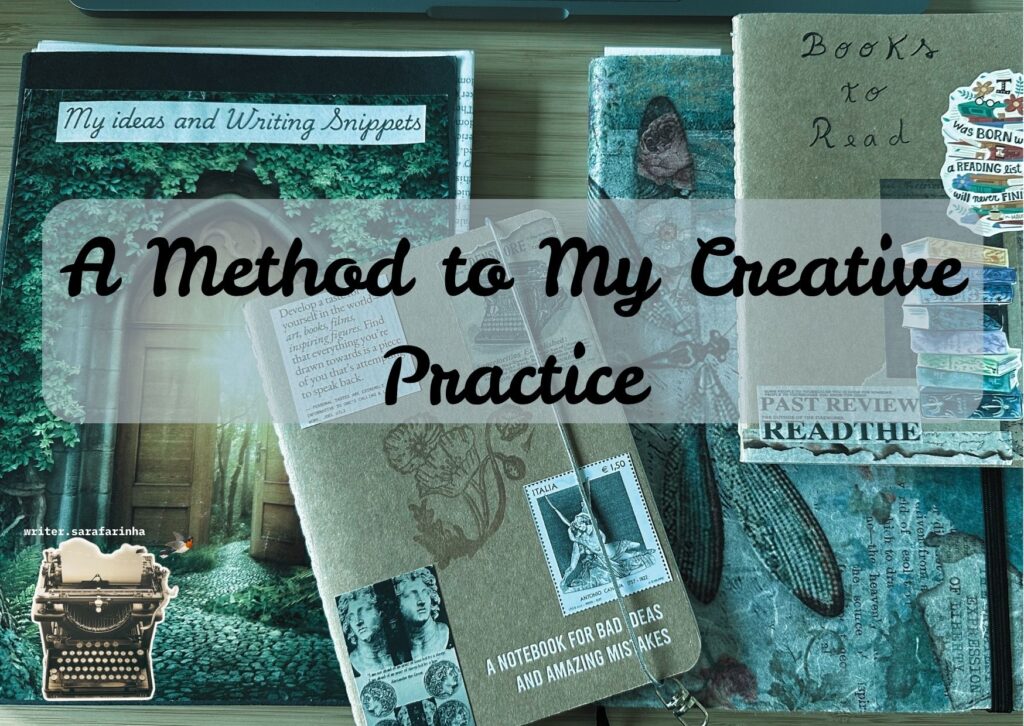
A Method to My Creative Practice

method to creative practice

Hello all! Welcome back to this blog.

Let’s talk about writing… Let’s talk about my writing method.

These are the first three steps of the creative method that I’m trying to structure at the present moment:

1. Learn

2. Capture

3. Practice

If you read last week’s post, you may be aware of my attempt to organize my own creative method, and the path of better structuring the knowledge about myself, and how it impacts my own creative method.

This is a recurrent theme, to which I have dedicated much time, and that I want to share, as I’m weaving my way into its construction.

I believe we have the need to construct our own method, to which we will be able to turn to, whatever our current state of mind at any given moment. I feel this is essential to maintain a satisfactory creative existence.

I figure that to nurture one’s creative life we have to be able to see the nuances of the practice.

Contemplate a sunset, as he drops below the ocean, may induce me to go create something. But, many times, is the image of a, not so beautiful, ant that struggles with a crumb, that makes me think of moving impossible objects. Or, looking at a broken sea shell, and realising that its mother-pearl does not lose the creamish-pink beauty just because it has jagged edges.

So, why do we feel we need this sort of trigger to create something? And what do we do when he does not manifest itself at present? What art works do we create when the world pressures us in brutal, and hard to reconcile, ways if we need the peace to inspire us to create?

Not every one of us are prone to social intervention art creations, or aim to build art that will change the world. Sometimes, escapist art it’s the best contribution to society one can give, to the thousands that need the boost of a helpful piece.

To facilitate the trigger that leads to creative construction is part of finding our own personal method, which allows us to work on our art, without depending of the mystical and elusive inspiration.

To wait for inspiration to start creating is not a long term sustainable creative method.

But, to be aware of what surrounds us, in accord to what we thing about such experiences, is the fountain from where we drink to create, and part of our own personal method.

To think in showing up to a page and write something, is to know that, if inspiration is pushing us to ‘create! quick! don’t think, act!’ the process seems easy.

It appears to be what we have heard of what an artist should be: struck by a genius idea, and the rushed frenzy of putting the idea into the work of art, whichever form of choice… a page, a canvas, an uninterrupted role of paper, a digital file.

But, how many times does this happen? And how do we build a regular work practice when all we do is create when we are inspired?

I believe that it’s in moments of quietude, those which are spent contemplating outside things, while inferring what’s happening inside us, that feed the creative act.

To see something differently, and regularly build and adding to its meaning, means that we need uninterrupted time for the creator with its thoughts, and a multitude of experiences that help him recombine his ideas.

It’s not the velocity that provides consistent work. It is the stable progress, discovering in little increments, and showing up to organize which are our ideas, about the artistic means we have chosen.

It’s in the nuances, in which we build ourselves that we may, and should, come up with the system that helps us lead a creative life.

It’s in the experienced differences, in ways of being and creating, that need to be respected when we establish our own creative method.

Not forgetting that, to learn from other people’s experiences is essential. After all, we don’t know what we don’t know, so we need to go and look for it. To gather ideas and knowledge is essential to any person, more if we speak of someone which desires to do creative work.

To organize our own experiences, with the intent to base a system with which we are intimate, and that guides us, is essential to the creative practice. We need to know what we are doing next, without too much pause or friction.

To know ourselves, without prejudices or artifice of exaggerated productivity, help us acknowledge when we work better, when we have the means, and when our experience is inspiration to something more objective.

And from this point on?

To learn through a pletora of sources.

To capture what we know, and what we continue learning, in ways that nurture the creative process.

And always practicing our art.

My best method, or that which I recognise as the beginning of my creative process, has three phases: Learn; Capture Ideas; Practice.

Which always happen simultaneously. This is because, to capture ideas which seem interesting to explore later is a constant process to be kept. To have a place, or several, where to note things down, is part of my resources always carried with me. And, to write it, practicing the art, is an essential output.

1. Learn

Learn the relevant techniques. Learn what others, before and contemporary to us, have added to the themes. Learn the basic details, and the more advanced knowledge, as is possible. To learn is the Creative Input that we need.

To ponder: Sources. Quality of our Sources. Diversity of experiences. Research work. Thinking process. Iterating processes. Hyper-focus on what we are captivated by (no guilt).

About exposing ourselves to different experiences: what we experience embeds itself in who we are, and what we do. To broaden our activities, meet people, go to spaces and experience other artistic manifestations… we end up finding out that we really love to collect theatre brochures, photograph art pieces, rock climbing, volunteering, going to music concerts, pottery workshops… whatever it is that makes us happy and ready to use that information/inspiration.

All materials, or experiences that teach us something, are valuable.

2. Capture

At the same time, learning implies to have the means to capture what we learn, and build the personal iterations about the different matters.

External: I have experimented almost everything that I’ve came across, on the process of Capture of relevant information, and the ideas that were brought from those experiments. Even on my most difficult moments, I have tried to keep my records and even adapted this process, when my health required a more thorough process of capture, than the one I was accustomed to.

Daily calendars, online calendars, diary, dedicated notebooks to each project, photographs, photocopies, commonplace books, A5/A6/A7 cards, text and calculation files, organisational apps, right until creative challenges that asked for a continuous writing, painting or collaging, for a set number os days, a precise and regular practice… I have experimented all that sparks my interest and I find it most enlightening of our personal tastes.

For now, I have a small notebook for Capture all the information. And this is a entryway which works for me. I prefer to have this capture notebook, accompanied by the notes app on my mobile, adding the pertinent photographs to my photo library. I am also a frequent user of Canva, in order to organise all this input of information.

From this Capture notebook, I then copy the information to the correct project notebook. If its an idea for a book, I’ll put it in the project notebook. If it’s a reference to add to an article , I’ll put it on the first drafts notebook… and so on.

All these project notebooks have started to be organised in a particular way but, about this, I’ll write in some other article, if you have interest on the subject (let me know in the comments).

Internal: What I Capture might generate an idea. I’ll write it down in the capture notebook, and add a photo or other relevant material, to remind myself from where the idea came from. For example, all that comes to me when I read a book is noted on the margins and copied to the Capture notebook or dedicated Project notebook, as soon as possible.

I’ll let my internal monologues be influenced by what I see… if it’s a painting, and it reminds me of a character, or a possible personality trace, I’ll capture that connection and, later, I’ll transcribe it to my project notebook.

3. Practice

Every first draft, whichever project, has a dedicated space. A physical or virtual space that does not obey to any revision work. I’ll write what I want, in a first draft so messy as he requires, and leave it on the waiting cue.

Some books take years until I figure out what a better draft requires.

Writing blog posts and Substack newsletters take less time than other forms of fiction writing, but some of these never see the publication date arrive, even after days on end of revisions. “One simply is not fit to be seen.” (‘Persuasion’ by Jane Austen)

Other blog posts, end up supplying the main idea to other article, even if totally different from the initial iteration.

To put something in the world, the Creative Output, is the main goal of the previous actions: learn and capture.

Memorize to future use

In light of this, I cannot help but think that it is important to consider memory as essential to it all. This creative method is, simultaneously, a group of strategies that help me keep the information that crosses my path, so I don’t forget, to repeat it until I memorize what I need, in order to recombine ideas, and use them in my writings.

This is a process that helps me remember what’s important, and the most relevant details from those experiences. If I did not make the effort to write down, and remember, the positive experiences, soon only the negatives would have space.

Life is made of too many memories, which we unintentionally forget, or that we need to arquive somewhere in a less accessible spot. But, to practice our arts we need memories, and the ability do memorize, and not just those which are more emotional impactful, but also the ones less dramatic.

To have processes in place to maintain constructive memories, that I wish to keep, has been determinant to my memory, and helped narrowing the uncertainty of some memories, even if it does not save me from the normal cognitive biases, that are certain and assist us all.

So, these are the first steps of my creative method: Learn. Capture. Practice.

Not the solo ones of this method, of course. But they are the infrastructure on which I build upon. Part of growing my own garden.

I hope this glimpse of the entry point on my creative practice is of some use to you. I’ll share other strategies and methods in due time.

Subscribe for more writings about Writing. Help me grow this blog and keep on sharing the writerly talk.

Bye and Keep Writing! ✍
Grow your garden. Find your method. Create your art.

grow your garden

Hello all! Welcome back to this blog.

Let’s talk about writing… Let’s talk about your writing method.

Have you been searching for a method that helps your writing? What are you doing about it?

This is me, constantly searching for the best method. I guess, no other literary activity has capture my attention like searching for processes that could help in my writing practice.

But, how may I find my own writing method? Find or create it?

In ‘Candide‘, Voltaire writes: “One must cultivate one’s own garden.” An aphorism that has been interpreted in different ways. To me, it means to take care of our own domain, to find our own tastes and methods.

Because when we talk about the creative act, there’s always a confusion between what may be considered a hobby and true work.

As I’ve been told, in repeated circumstances, it’s common-knowledge that we can’t make money with a hobby. Not seriously. As soon as this happens, that said hobby turns into a job, and from that point on, everything gets more difficult. Creative ideas flow away, the pleasure from the creative act itself disappears, and purpose solidifies on obligation instead of satisfaction.

It is said that if we go in search of a method that helps us keep a creative practice, — even if we feel discouraged by the expectations we had, not having how to assure any achievements,— the probability of finding dozens of methods that work for others, and still may work for us, but of which we cannot stick to and make them our own, is huge.

To experiment new strategies, different methods that seem productive and interesting, can be a potent motivator but they are not a miracle in a fun package. Not forgetting that, meanwhile, we are adding a pletora of knowledge (learning from others), ways of doing and thinking things differently, some with better results than others.

Different projects means the use of different methods, and the need to adjust the process, or parts of it, to the theme itself. Each project will require a different version of the process, suitable to that particular construct.

There’s no scarcity of creative methods to adopt, but the one that makes sense to me it is not someone else’s method. Does it seem arrogance speaking? It is not. I am grateful to all the sources that informed me, and helped me go search for my own writing method. Other methods have inspired me in the constructing the idea for my own method, and I have learned immensely with others articulations about different writing subjects, past and present influences.

I find that we develop a particular taste for those things that dazzle us. So we follow our intuition and go towards those things that enchant us and help us create something of our own machinations. And this is the principle to a valuable method. My method.

To come across our own particular taste for something is invaluable. And to find our true will to write, — or to do the creative activity of our choice, — while feeling the appreciation for the act in itself, not just the product after completion, but the joyous Doing is the best method ever.

Of course that, if this was easy everybody would do it. Sometimes is very hard to appreciate the work of doing something. But, to not appreciate parts of the process, doesn’t mean we should give up. On the contrary, if we can find pleasure in what is hard, boring or tiresome, we find an advantage on the work itself.

Maybe the ‘better method’ problem resides in our will to get results, without ponder what does it really mean to do the work. How much the creative work requires from oneself and our personal reality. Our own personal method, independent of the learnings that we benefit from, must ground itself in who we are as a person, as creatives and as members of general society.

As a person, because our daily life, health and economical means have a big impact on our creativity. As creatives, because access to different things and our own personality have a direct link to our art. And as a member of society, because there’s always expectations and contributions that we have to do towards family and the assorted communities that we are active part of.

I suspect that the best method only depends of the best professional, writer, creative artist that we can be. And nothing else.

So, I ask: Who are you as a creative constructor? Where do you find inspiration? What are your processes? Through what actions do you feel motivated to do the work? Do you recognise your own method glimpsing through the outer noise?

Subscribe for more writings about Writing. Help me grow this blog and keep on sharing the writerly talk.

Bye and Keep Writing! ✍
Let’s talk about bad writing and Stephen King

bad writing

Hello all! Welcome back to this blog.

Let’s talk about writing… let’s talk about bad writing.

Writing is a skill. We learn the basics, we spend years practicing, we devote ourselves to the genre or outlet of our choosing (because there’s a difference between writing fiction, a blog post, or an essay), we keep at it until magic is made.

“At its most basic we are only discussing a learned skill, but do we not agree that sometimes the most basic skills can create things far beyond our expectations? We are talking about tools and carpentry, about words and style . . . but as we move along, you’d do well to remember that we are also talking about magic.” — Stephen King, “On Writing”

“On Writing” has been one of the books about the writing craft, that I always see mentioned, whenever there’s somebody writing about writing.

And Stephen King isn’t afraid to point out bad writing practices.

I have read this book a few years ago (in 2011, according to Goodreads), and it made an impression. Still, I haven’t reread it… or hadn’t until this post put me in the mood to go and find it. And to find it I did.

“I believe large numbers of people have at least some talent as writers and storytellers, and that those talents can be strengthened and sharpened. If I didn’t believe that, writing a book like this would be a waste of time.” — SK

About Talent and Practice:

Talent is overrated. If we just look for potential, we see it everywhere. But to have it materialize into actual value, there’s another matter entirely. And to develop writing skills is essential to be a fiction writer.

I recall the first time I understood the diference between Showing and Telling. I remember wanting to do a just Showing book. Yeah! People do have strange ideas when they come across something interesting. I still have that moment near to my heart. Why? Because in the next moment, I figured out that to do all Show and no Tell would do a disservice to the story.

I found that some formats gain from a prevalent Showing instead of Telling. And that in every work we need to have exposition as well as action.

Some of these things I learned only with practice. After understanding what it meant, and analysing what I was doing, and flipping the text around just to find out if there was a better way to write the tale.

To write that “the rain poured down, drenching his clothes.” or to write “In seconds, the dark skies were upon him, his clothes weighted a ton, and the cold clang to his skin, as the downpour hit him.”, gives us ideas on how to pull the reader in, and make him feel that he is right there with our character… getting outright rained upon.

As E.L. Doctorow said: good writing has to evoke a sensation in the reader – ‘not the fact that it is raining but the feeling of being rained upon.’

These are learned skills and still we need to let ourselves loose so we might find magic in it. Understanding the rules, learning the basics and attuning the skills we need to write, clears the fundamental space we need to make art happen.

The object isn’t to make art. It’s to be in that wonderful state which makes art inevitable. — Robert Henri

And this is not just in inspirational terms but also in craft basic skills.

About Fear and Bad Writing:

We fear to write what we know. So we choose not to write at all. We fear to write somethings, so we choose the most bland and uninteresting thing there is. We fear not to be good enough, so we end up quitting. We loose dept and strength when we let fear tell us what to do.

I’m convinced that fear is at the root of most bad writing. If one is writing for one’s own pleasure, that fear may be mild—timidity is the word I’ve used here. If, however, one is working under deadline—a school paper, a newspaper article, the SAT writing sample—that fear may be intense. — S.K. (p.127)

But when some sort of practice takes place, and we keep at it, there’s a sense that working through the fear is part of this process. There’s always fear when something is important enough.

But that’s why we have courage. 

Every time fear shows it’s face, courage comes right behind him and makes him fall back. At least that’s what is expected.

And it will do it every time. Not just a one time thing, but every time something makes us doubt and fear, courage has to step in and put fear in his place.

Just Writing:

Bad writing is fearful behaviour. To choose this word or that word, overly preoccupied and attentive to what might sound like, and be like, and having other people’s rules in mind all the while we are trying to construct something… it’s tiresome and not a good process to have at all.

Good writing is often about letting go of fear and affectation. Affectation itself, beginning with the need to define some sorts of writing as “good” and other sorts as “bad,” is fearful behavior. Good writing is also about making good choices when it comes to picking the tools you plan to work with. — S.K. (p.128)

To write as good as we are able, means to choose our toolbox (Stephen King’s concept) with intention and knowledge. To have a discernment about what goes inside our writing craft toolbox so we are able to build with using the good tools we have been collecting.

Bad writing might be just unexperienced writer. And a competent writer might be an uninspired one. But a good writer? That takes talent, practice, a good toolbox and some extraordinary instincts… and life experience.

I can’t let this one out. Life experience is what shines through in the mist of our works. The things we experienced, the things we lived through, the knowing in our bones what it’s like to be there, to feel it. It’s the school of life experience that keeps a writer going and gives dept to his work.

As Georgia O’Keeffe wrote, in one of her letters:

I feel that a real living form is the result of the individual’s effort to create the living thing out of the adventure of his spirit into the unknown — where it has experienced something — felt something — it has not understood — and from that experience comes the desire to make the unknown — known. (…) Making your unknown known is the important thing — and keeping the unknown always beyond you (…) that you must always keep working to grasp (..) — Georgia O’Keeffe

We live, we read, we write. A lot. Of all three. 

Subscribe for more writings about Writing. Help me grow this blog and keep on sharing the writerly talk.

Would you like to know anything about me? Please leave a question below and I’ll reply asap.

Bye and Keep Writing! ✍🏼

Find inspiration of different sorts and build a creative identity

find inspiration

Hello all! Welcome back to this blog.

Let’s talk about writing… and about using different sources of inspiration to better ourselves and our writings.

Why do we need to inspire ourselves to create? Why do we find that our artistic output to be a blueprint of who we are?

We write what we know.

Yes, I know this idea has become so commonplace that it is seen as just a cliché without any worth to it. It is cliché, if we do not understand what it means, and do not make an effort to recognise what it stands for in our work. It is a cliché if we just throw it around, without fully grasp what it means, and how we need to use it.

But that it’s not how I perceive it to be.

Write what you know stands for: To recognise what make us ourselves, and to see it in our creative work.

And these are two difficult things to do. To know our ways, to build upon them, and to see all of it in what we create.

Ultimately, I believe that we will not be able hide who we are in any creative output. So, it is indeed revealing.

And not just to know others… But this is a different theme, that you can read more about in the post Know Thy Human.

When we practice painting, for example, we put in the hours of work until our style is recognisable. Until we, ourselves, and our identifiable style comes through our work. We choose to create/reproduce images in a way that is familiar to us, and that ends up representing our personal style.

Some painters bodies of work are gloomy, others are colourful, others are free style, or nature inspired, some are impressionists, others are modern, and so on…

It is the same process for us writers.

We start writing something, in whatever means, genre, or format, and as we put in the hours, our style becomes more and more defined. We start perfecting it, even if we do not have a sense that we are doing this betterment process. And, some time later (10 000 hours later?!) we get a sense that our output has changed, our way to deal with subjects has changed, our style has evolved. We have abandoned some things, and took upon us to enlighten ourselves in others.

If we keep at it, eventually our style will be recognisable to the people that read our work.

While we are at our practicing periods, we end up feeling that we need inspiration from other people’s works. So, we go in search of it.

This process of looking for, contemplating, learning and appreciating, other works — paintings, conversations, views, sculptures, books, and all sorts of activities that get inside ourselves, — begins. And then, its revelations come forward through our writings.

To each one of us, some mediums will be more appealing than others. Some ideas resonate more than others. Some mediums might be more suitable than others.

Some will love poetry more, while others find that listening to nature sounds are more suitable for their creative processes.

For example, I have been enjoying a documentary on YouTube that I suggest you to a look: Anselm Kiefer: Remembering the Future

I always find myself attracted to big, dark, dystopian works. Maybe, because I usually find myself engrossed in heavy feelings, whichever the means they are presented in. I appreciate the subtleties of how different people respond to personal history, and how it influences their creative process.

But, to look for ‘knowing more‘ shouldn’t be a chore.  

Most of this research isn’t consciously chosen.

We follow things that make sense to us. Things that makes us crave more knowledge, that we feel passionate, and just need to know more about.

We do not think, let’s go and look at some paintings, or some documentary, and maybe I will feel inspired to write. No! We might expose ourselves deliberately to a work of art, but how it interacts with our creative processes is something beyond the cognitively perception that we will be influenced by it.

And this is why we gain in exposing our minds to new experiences. And not just the good, happy stuff. All the bad and gritty things we will look upon, will come bearing fruits. There’s a most likely chance that the less obvious thing, will not be overlooked. It will not be discarded, even if we do not like it, because it will build upon on some point, that we will find suitable to make in our works. We will use the knowledge, to prove or disprove it. It will become our own.

As we live, we will learn to recognise more of what influences us. And we will learn to find explanations, so very different from what we thought they would be, and to discover other ways of living through other people’s art. And, ultimately we end up incorporating and using knowledge, that we didn’t even knew we consciously had gained. And our work will be better for it.

Our writings will be better at each instalment of novelty. At each knew discovery of something we love, as well as of something we hate.

If we see more of whatever it is that we find appealing, or repellent in this world, we will surely have it seep into our works. That’s why artists always navigate toward a specific worldview, which comes through in their works of art.

People who have seen war, fighting and death, will be more inclined to use those themes in their works. People who fancy a more nature inclined living, will make art using that. People who are dumbstruck by people’s extreme acts, will try to make sense of it all, and so on…

Finding different sources of inspiration, helps us know more about what encircles us and about ourselves, and therefore, define our style in a more personal way.

Let’s open up to ways to invite novelties to us. Let’s accept hardship and struggle. Let’s invite knowledge in, so we may get it all out of ourselves through our creative work.

Please subscribe for more writings about Writing. Help me grow this blog and keep on sharing the writerly talk.

Would you like to know anything about me? Please leave a question below and I’ll reply asap.

Bye and Keep Writing! ✍🏼

Books on the Writing Craft and other matters at hand

books about writing

Hello all! Welcome back to this blog.

Let’s talk about writing… and reading towards our writing practice.

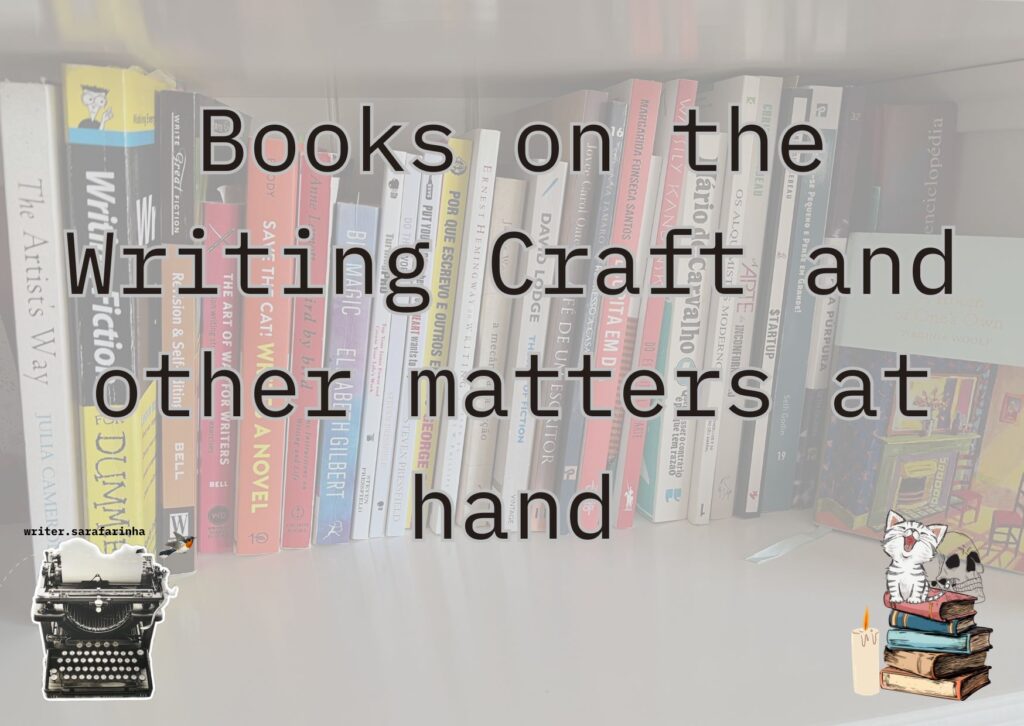
On this article, you’ll find some ideas about formal studies, the need to keep learning, and the books that I’ve included on my learning practice about the writing craft.

Yes, I made a list with all my 5 star reads on the writing craft. Enjoy!

And tell me more… What have you read? What are you reading? Recommend some books to me?

So… About formal studies

Formal studies teach us to read, focusing on goals. School gets us the reading practice oriented to themes, and learnings that we need, in order to perform… mostly to perform in tests, but if we have writerly aspirations, it gives backbone to our efforts.

Later, and as we exit the formal education system, all we bring with us are the systems taught, while learning the official programs.

And many of us, also bring an intense dislike by obligatory readings.

Out of school and into self-learning…

Out of school, no more learnings? No. Self-learning is part of the writing (and living) craft.

To make use of a more formal approach to learning, even if we are out of school for good, can make the diference we need, in order to write better.

After all, if we are not in the formal circles is a lot more difficult to be exposed to the basics, because it’s what school give us: the basics.

At this time, we have licence to go and study by ourselves whatever we want to learn.

Of course, that Learning is hard. Not just while in the formal teaching institution, but also by ourselves. We tend to be lenient towards what we have to do, and want to do. It takes a lot of discipline to really live the scholastic life, when we frankly don’t have to.

So we struggle.

Best versions of ourselves are hard to grasp

Trying to find things that motivate us to learn more about, or read more about, and failing on maintaining that energy is the usual cup of tea.

Also, having the means to do it (time, money, will…) is usually a hard combo to achieve. Means are usually scarce, and it’s hard to get our hands in the best version of the knowledge, we need to have access to.

And it’s just better not to bother. It’s easiest not to do it. Or to pretend to do it, and just give an half-ass efforts into it… And then we end up more hurt by trying it half way, instead of going all in.

Because we fail to see the reward, we put moderated efforts and get frustrated when things just don’t pan out as we wish. We want it all, but fail to give it our all.

A clue…

Set some order on learning efforts. Have a more organised approach to subjects and just do the time on the work. Read the book, do the training, have the workshop, write the text…

And, in the midst of setting my own learning practices, I give you the most important learning resources I have come accross in the past fifteen years.

So… I give you some books about the writing craft, that have made a difference on this learning journey. Just the 5 stars reads that were useful and fun.

Books on Writing

“Revision & Self-Editing” by James Scott Bell

About the most important aspects of writing and the impact of revisional work and self-editing our writings.

“Turning Pro” by Steven Pressfield

A motivational book identifying a force known as Resistance, and how it impacts our creative efforts.

“Letters to a Young Poet” by Rainer Maria Rilke

Some well thought advices, from a most beloved poet and letter writer, that guide us through the sacrifices that the work demands from us.

“Turning Home” by Susanna Tamaro

Reflections about living a writerly life and how her personal experiences shaped her, her longings, and her fictional writing.

“A Room of One’s Own” by Virginia Woolf

Getting to know the irony that shaped this women, in her writing acknowledgements and achievements, is a priceless lesson, humorously put.

“Word by Word” by Anne Lamott

Invaluable lessons on the most common (and abstract) problems about writing and living a writer’s life. A guide to our more common feelings towards the writing predicaments.

“Big Magic: Creative Living Beyond Fear” by Elizabeth Gilbert

Stop romanticising the hardships of the creative life. Accept the mystical of the creation act and find happiness in writing.

“Escrita em Dia” by Margarida Fonseca Santos

Useful exercises on the writing craft, helping unblock ourselves, and finding rhythms in our creative practices.

“Nobody Wants to Read Your Sh*t: Why That Is And What You Can Do About It” by Steven Pressfield

A non-nonsense way of looking to readers realities. We might as well face it and learn to do better to captivate people’s attention.

“Zen in the Art of Writing: Releasing the Creative Genius Within You” by Ray Bradbury

Inspiration and the celebration of the writing life.

“The Art of War for Writers: Fiction Writing Strategies, Tactics, and Exercises” by James Scott Bell

Strategies and thoughts on writing, through the lenses of the first manual written on war by Sun Tzu.

“The Artist’s Way: A Course in Discovering and Recovering Your Creative Self” Julia Cameron

Unstuck yourself with this 12 weeks course on how to create and be creative. Find out the easiest way to accept that we are all creatives at heart.

“Bird by Bird” by Anne Lamott

Writer’s themes are dealt with with humour and simplicity. A precious help on the more usual predicaments about the writing life. And it’s good for the non-writer’s as well.

“The Faith of a Writer” by Joyce Carol Oates

What a writer believes, and writes about, and how an honest take on the writerly issues can help us cope with this life.

“Why I Write” by George Orwell

A short essay on his motives for writing, so similar to our own, and interesting to compare to.

“Quem disser o contrário é porque tem razão” Mário de Carvalho

A Portuguese author’s take on the writing life, and writerly themes, setting the tone with: there are no absolute truths, just opinions on subjects and actions we take.

“How to Read Literature Like a Professor: A Lively and Entertaining Guide to Reading Between the Lines” by Thomas C. Foster

A funny, well versed, intelligent professor gives us the written version of his usual classes on Literature. With the so well put knowledge, we learn to see beyond the works and criticism on literary works.

“On Writing: A Memoir of the Craft” by Stephen King

A glimpse into his thoughts on the writing craft throughout the years, and his multiple experiences with being the struggling, and the successful writer.

“Writing Fiction for Dummies” by Randy Ingermanson and Peter Economy 

The nuts and bolts of writing through some studied methods. This is a how to book, worth the immense time it takes to read and apprehend it fully.

There are others, but not 5 stars reviews, so I’ve kept them out of this list. These are my most precious and inspiring book on the writing craft.

Reading and self-learning efforts…

This year I have a reread already lined up, and a new book on the craft.

The reread will be “How to Read Literature Like a Professor: A Lively and Entertaining Guide to Reading Between the Lines” by Thomas C. Foster. I just got the paperback copy and want to read it in this format.

The new book is “The Elements of Style” by William Strunk, which I hope to get to soon.

Meanwhile,

I discovered some 4 stars right here on my shelf, that I feel have been neglected. I have read them, but I feel the need to reread and see what I missed on the first time, that made me give them a 4 star rating. These are:

“Ernest Hemingway on Writing”, edited by Larry W. Phillips

Some quotes and curated excerpts of Hemingway’s works related to the writing craft and his practices.

“How Fiction Works” by James Wood

A literary essay on criticism, literary artefacts and craft tricks writers use to deliver their messages.

“The Art of Fiction” by David Lodge

Prose for the newspaper readers, as he gathers a topic from a well-known novel and uses his literary experience to enlighten and delight the common reader.

I feel all of these need a second turn on my reading radar.

Getting Back to the basics…

I have wanted to be exposed to the basics, and I’m working through some kind of writing bibliography, in tandem with reading fiction.

But I feel I need to have a more dedicated study practice. And this is something to chew on for a while… Set some guidelines and do the work. I’ll let you know how this goes on future blog posts. 

See you next week! And, meanwhile you may checkout my social media and subscribe to this blog.

Please subscribe to the blog for more writings about Writing. Help me grow this blog and keep on sharing the writerly talk.

Would you like to know anything about me? Please leave a question below and I’ll reply asap.

Bye and Keep Writing! ✍🏼

Writing it forward and setting goals

writing it forward

Hello all! Welcome back to this blog… Let’s talk about writing and goals for 2024.

Does anyone knows how to set proper writing goals? I, sure as hell, never feel like I do.

To make it just numbers-as-achievements doesn’t work for me, because I’m a too slow writer for it. There’s no way I can find my flow in the constant run of writing whatever to accomplish a quota.

To make it project-related, always feel like I’m letting things fly away from me. Again, as I am a slow writer, I get myself into struggling with stuff, and then I pause the project until I figure it out.

So about my writing goals… I just know that I have these projects that I have been working on, and I need to get back to them.

Moving forward is always so hard, specially when I know I need to have some sense of a finish line. But I don’t know how to make that commitment. I’m certain it will come to me whenever it’s time.

Also, for me at this point, to plan some writing routine seems quite impossible. Life is happening here and it’s not warm and fuzzy. So, I know I’ll be writing. I know in which projects I’ll be writing. But I don’t know how I’ll manage the time to do it.

Still, pushing forward it is.

First, I know I need some new habits. Or, at least a return to my most productive habits. Things have been getting complicated on the domestic front, and my writing time has been absorbed by a lack of sleep discipline and tantrums. Not mine, though… Not that I don’t feel like throwing some… at this point.

I’m hoping 2024 will bring some new habits and, with them, nights made for actual sleep. And, with more sleep, I’ll finally be able to insert my morning writing routine on a proper hour… right around 6AM. But maybe this is just some wishful thinking.

So, about setting writing goals…

SMART GOALS

SPECIFIC: What do I want to achieve?

There are three Writing Projects, on different stages of production and I want to get each to its next step.

MEASURABLE: How do I know I have achieved it?

To get to the end of the current stage of production on each project: To write the zero draft. To finalize the final read. To edit the 40 poems.

ACHIEVABLE: How to make it true?

There are no impossibles to achieve on my three ongoing writing projects. Everything’s achievable about these.

RELEVANT: Is it worth it? Is it relevant?

To write, in a writing life, is relevant. To get these ready to be read is very worth it.

TIME BOUND: When will I achieve it?

In 2024?! No. Being more specific about this. I’m setting the first trimestre of 2024 to have the #2 project zero draft done. Then, I’ll reread the final version of the #1 project. On the first six months #3 project will come to the forefront in specific times. Second half-of 2024, will see the needed update on these goals.

SO…

These three projects have been in the oven for a while now. Each have their particularities and personal involvement issues. 2024 will see them tackled and accomplished.

Still, I’ll be scarce on the actual numbers. After all, I’m not too good in keeping numbers running smooth, and I don’t want to discourage myself.

On the other(s) writing projects…

In the writing forward departmentbecause they are the most immediate way to reach out to readers — I’m keeping focused on the blogs.

Writing forward is important to me just because I feel more connected to the people that visit my blogs.

These are the virtual places where I might make more difference. Where I get to motivate, and try to inspire others, to see their life as pure creativity, and to pursue their arts and crafts, specially the writing craft. This has become a big part of my efforts on the writing it forward front.

When I struggle, I’ll take you with me to learn from my mistakes… like I’m doing now, with the setting up goals from which I’m scared of. And when I accomplish some milestone, you are right there with me.

So you can watch the view and jump in your own pursues as soon as you are ready… or just, jump in now. Subscribe to this blog and never miss a beat on this Writing Life Log: WLOG?! 😀 I know! Enough with the weird acronyms.

Focusing on…

This has been what I have been focusing on: to write about things I love.

Might it be in my fiction, in my writerly blogs, and even in my poetry, and in my Vlook YouTube videos.

I just want to write about things I love. Books, trips, stories, challenges, love… things that speak closely to my heart.

New endeavours…

In 2024, and you are reading this here first!, I would like to come back to the short story format, but I do not have a settled plan for it. Still, I have been entertaining the idea for a while. We will see if it goes somewhere.

Above all, I plan to find some satisfaction in the ongoing projects. Because this is more important than to bound myself to some metrics in a plan.

Not that I don’t find numbers important, because I do. But, sometimes I get a weird feeling that, if I put up too many boundaries, to myself and to the completion of my work, I end up unable to create anything.

It’s like I get bound by the lack of willpower to comply to the set numbers on the goal page. I get overwhelmed by all of it and shut down.

So, I don’t do that anymore. No strict numbers for me. Not in this.

I am no child, I can carry my own projects to good term. — and this is my Emma Woodhouse talking.

I need to feel that I’m open to change and magical creation, not under a whip, pressed into forced labor. Which, not being the most desirable discipline, it’s the one I need, to keep myself working on my creative plans and goals.

I hope you’ve been working on your creative projects. Hope the first days of this new year have been kind to you. Hope you are positive into the upcoming year and your creative contribution to the world.

See you next week! And, meanwhile you may checkout my social media and subscribe to this blog.

Please subscribe to the blog (and other social media channels) for more writings about Writing. Help me grow this blog and keep on sharing the writerly talk.

Would you like to know anything about me? Please leave a question below and I’ll reply asap.

Bye and Keep Writing! ✍🏼


Writing, breaks, stories, movies and social media

christmas breaks

Hello all! Welcome back to this blog… Let’s talk about writing and downtime from writing.

The holidays are here, or they are almost here. Christmas is right around the corner, and many of us decide to align the things we have to do on the holiday’s front (shopping, family and travel), with some sort of pause of our daily tasks.

But having other things to do, or needing a break, doesn’t mean that I am at ease with it.

I have some questions for you (if you would like to share):

  • Are you taking a break?
  • Are you using some sort of downtime from a full-time job to write?
  • Are you planning on write or work on your writing in the last two weeks of this year?
  • Or you are really going full out on vacations and give yourself a break from writing?

Is it normal that I never know what to do? Does it happen to you? Even knowing that I’ll eventually will have to change routines and have other things to do in these days?

I know, I’m on family-duty and full-time on taking care of my child. I do not know much more than that. Events are fluid, specially with a in and out of a cold child.

I know I have a Zero Draft to finish and a New Year to continue Planning. I know I’m trying to think ahead, and do my blog posts in advance, so the holiday’s do not make me feel seriously lacking in the blog posting department.

I know making content for social media has been shoved to the side for weeks now. I’m not on a sharing mood.

Not that I can see any returns in the free marketing strategy. And I’m not on board with supporting the big (unjust, morally degraded, greedy) companies by paying them for an exposure that they’ve built against intentionally. Hello, algorithm!

See I’m a member from the Cheap Generation… In my country my generation was named Cheap, due to some intended public offense towards teens, at the time. We were the cheap generation (original: geração rasca). What they didn’t tell us was that we would always by scraping by… which seems fitted. I was born in the tail of the seventies, so I’m on the Generation X transitioning to the Millennial, and this means I have lived the birth of all this social media. So do not talk to me about algorithms as if it was unavoidable downside.  The objective is to make money from users, and so they figured a way for regular people to pay for ads (to which we have no control of and therefore can’t attest that we are getting what we paid for).

Except if they get paid to flip some political agendas… Or to sell people’s data. In these cases, there are no boundaries to the do it all of the algorithm…

“Your Scientists Were So Preoccupied With Whether Or Not They Could, that they didn’t stop to think if they should.” — Dr. Ian Malcom on Jurassic Park movie (1993).

Just because you can (make the content, develop the platform, sell data, endorse conflict, influence and power play…), it doesn’t mean that you should.

Well, it should mean that you wouldn’t do it, no matter what. Like that other quote that says:

“With great power comes great responsibility” — Uncle Ben in Spider-Man

Boundaries and lessons learned from the past and all… No.

Which reminded me of another great story, movie format called The Devil’s Advocate, 1997, with Al Pacino and Keanu Reeves. Not just about vanity, lust or temptation. Power and access to wealth, in detriment of love, health and family, are also big themes.

And I’m still to watch Oppenheimer, the latest take on the creation of the atomic bomb.

Maybe I’ll just stick to the Christmas shenanigans, and movies (No. I don’t think I can do Christmas movies anymore) and replenish my creative well. Maybe I’ll just go with Studios Ghibli marathon. I still have a lot to catch on.

Whatever I’ll do, I just know there will be stories to tell later. I just know it.

And it is as it should be.

What have you been writing? Tell me everything in the comments section below!

Please subscribe to the blog (and other social media channels) for more writings about Writing. Help me grow this blog and keep on sharing the writerly talk.

Would you like to know anything about me? Please leave a question below and I’ll reply asap.

Bye and Keep Writing! ✍🏼