Writing is a work in progress… so is rain

water

Hello all! Welcome back to this blog.

This week I have been working on revising ‘The Shapeshifters’, my current major work in progress. I am trying to work out how to do my first big revision on an english written novel.

I confess, I am quite scared by the task. After all, I have a lot to practice until I find myself content with my english writing voice (does it makes any sense to you?)

But I found myself really enjoying the rereadings of this story. I always find something to revise and correct and even that being the case, I feel quite taken with this story… and by mulling over about the next two books on this series.

My transitional period from NaNoWriMo efforts into revising mode got cut quite short. Usually I take a few months before getting back to a project but, this time, I really didn’t want to lose the momentum. So I got back into revising just a few days after completing this draft.

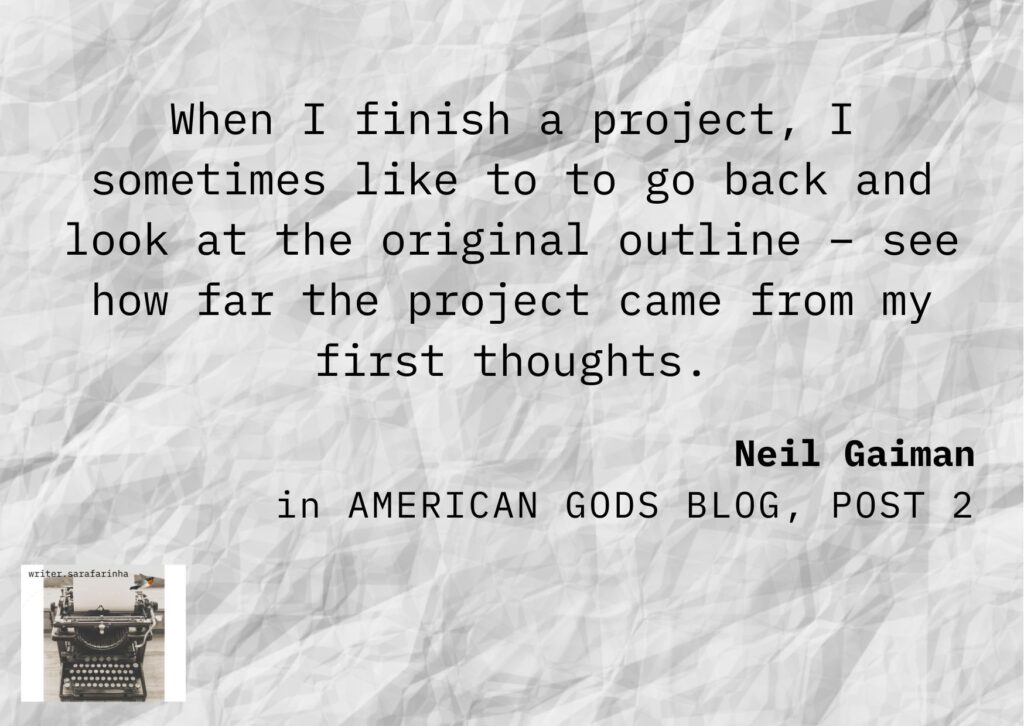
Quoting from Neil Gaiman’s blog post, which you can read fully here…
neil gaiman

I like to do this exercise also but, in this project, I feel I have been doing it since the beginning, always comparing notes with that first outline and see how I could improve upon.

I know my first outline didn’t have one third of what I managed to build into it on its third draft.

But I’m still not done with it. I want to tweak some details and to build solid foundations for the two books to come.

Paying other attentions to the writing craft

As I mentioned before (in this article here…), I’m experimenting Scrivener for my writing efforts and it’s been very fun. I find it very useful, specially in the writing and editing mode. I’m kind of exploring it as I go, and I am feeling that maybe I found a way to simplify some of my writerly messes.

And, for now, I’m just rereading it and tweaking it like that. Later, it will come the time to thoroughly research all the terms I have been outlining, and test for their consistency and service to the story.

Does it need a big edit or rewrite?

Honestly? I don’t think so… which just adds to the scary part of things.

It would be easier to handle if I perceived big flaws and went about solving them. But if I don’t perceive them does it mean that they don’t exist? Or that I am just not seeing straight? I guess this is just me overthinking… as usual. Or is it?

So this is all a big work in progress. One that I am enjoying thoroughly, even if it gets me unsure on lots of aspects. Now I intent to follow the schedule, keep working on this story (and the others to come), and do my best in building this universe I have been so fond of.

Some life updates…

Also, I couldn’t refrain from writing about our underwater daily life here in Lisbon, Portugal.

It’s been raining a lot, for more than a week now. We are a tempered climate sort of place, and people, and we are usually very unprepared for any real change in the weather. For the last week there have been lot’s of floods, and landslides, and occurrences derived from the excess rain water.

Yesterday, I woke up to water in the middle of the living room. It had been slowly entering the house during the night, infiltrating through the roof, descending the wall and pooling on the floor.

This is a major problem since it keeps raining, and no one will risk going to the roof, to fix the source of the damage. We are doing shifts in tending to the kind of cascading water inside the apartment and just wishing this rain to abade.

It could be worse. There are lot’s of other situations worse than ours. So let’s hope for clear skies and tend to our businesses anyway.

And this is why this post is coming so out of schedule… lot’s of water to clean ☔

Thank you so much for reading this blog. I hope you have a happy and tranquil December.

Please leave a comment and subscribe for more content.

Bye and Keep writing! ✍🏼

***

References:

Don’t let the noise get to you

noise

Hello all! Welcome back to my blog.

So, don’t let the noise get to you…

It has been some intense days here at this corner of the world. Lot’s of noise and inner chatter as usual.

I’ll give you a glimpse…

Christmas🎄 is coming in full speed, which means there’s lot’s of planning and a million of little things to do. Not to mention all the stress related with the shopping🎁 activities.

In these first days of December, I have been trying to rest a bit, because I’m still bothered by a persistent migraine… which really is a pain in the **head** 😅

Also, I find these days are a somewhat transitional period from the NaNoWriMo writing efforts (of 77 600 words) into a ‘what’s next?!?’ phase. And this aggravates me a lot.

And then it is the end of the year phase. Lot’s of reviews, and plans, and other stuff to do… I love to be well rested for planning mode but I figure this year is a no go on the rested mode.

Moving on…

This year I finally got the courage to grab one of my NaNoWriMo winner goodies by Scrivener (courtesy of Scrivener and NaNoWriMo for winning the 2022 challenge of writing the 50 000 words in November). And then I proceeded for installing the software and do the 30 days trial.

I started using it immediately for the project I have been working on, which I called ‘The Shapeshifters’, and I am really loving it.

I’m kind of in a learning process but I can already see the upsides to using this software. I have been hearing so much about it, but I find that I never really grasped what it could do for my writing and editing processes.

I am quite thrilled with it and have already started my editing process for this story.

So… the transitional period got cut really short and on December 2nd I started editing this story☺️

I came across a little quote I took a few weeks ago and it goes like this…

keep it simple

This quote’s context was about the practice of meditation but I figured it is applicable to other kinds of practices.

I have always thought these kinds of things, like Scrivener, were nice to have but quite dispensable. Most of this idea came from a budget tightness that never seems to allow for nice to have’s.

But I’m taking this seriously. I have been writing for decades and I can see this software serving all my writings for different formats and genres.

There is no fixed formula for getting our steps right. No full proof formula to approach our writing practices the best way. No grand scheme that gets us good results.

There are practices, and commitment, and lot’s of work.

All we can expect is to have the courage to look for what works for ourselves. And the insight not to overcomplicate things. And, above all, to refrain from all the noisy channels that keep blaring into our hearts why something shouldn’t be as it is.

It’s better to work with what is. To keep it as simple as possible. And to tune the noise down.

Yes, this is a very complicated time of the year for a lot of us. And we have different reasons for it to be so. I just get to remind myself that I work with what works for me, to keep it as simple as I can, and not permit the bad noise to get to me.

And to renew my commitment with this writing project… now, using Scrivener.

Thank you so much for reading this blog. I hope you have a happy and tranquil December.

Please leave a comment and subscribe for more content.

Bye and Keep writing! ✍🏼


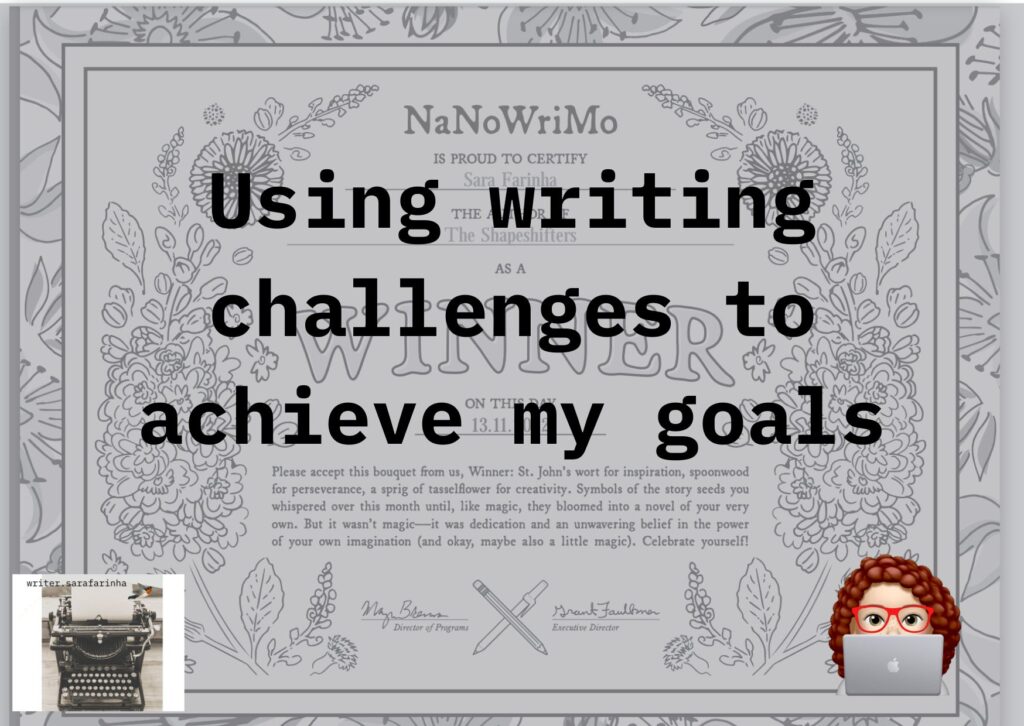
Using writing challenges to achieve my goals

challenges

Why is it easier to do something like NaNoWriMo in order to define my writing goals?

It might seem stupid, or not too professional to use these kinds of challenges to get one motivated to write. But the truth is, we lack structure for this dream we have, and that we want to see accomplished.

And the writing craft isn’t just throwing things on a page. 

Using someone else’s structure for our writing time, which is what these challenges provide us with, help us discover our own way of doing things. And pushes us to show up, every day, for the work we want to see done.

Let’s be honest, if you are anything like me, you’re mostly alone in the pursue of this dream.

Talking from personal experience, I have been doing regular writing efforts for more than fifteen years and the truth is, I can count from the fingers of one hand how many people were truly there, even if just to talk about all of this writing business… Maybe having someone to talk to about writing is the hardest part.

They keep looking at me as if I’m delusional…

And doing stuff all alone is hard, specially if we don’t know what we are doing, and need to find our own bearings first. I had had a messy direction in life, and only started to listen to my heart’s calling not so long ago. And I’m still trying to figure things out.

How to understand our Goals?

To know in our hearts what we want to do, and to put in the work we need to put in, when we don’t know how to do it, and where to turn to, and how to shut up all those little inside voices… and not just the inside one’s… It’s confusing.

And this is how I started to search the web looking for knowledge, and buying books that could serve as my mentors, and writing about this journey, and how all of these resources can help others like myself.

Finding my working processes, and defining my goals, are things in constant appreciation.

Hey! I have just started this blog for my english writing output, and I know I had been stalling for years.

I always had the goal of writing in English, but it took me too much time to show up for it. Why? I guess I was young and dumb… and scared shitless.

How can NaNoWriMo help?

First, it helps because it’s a fast drafting mode that doesn’t allow us to spend too much time doubting ourselves.

Second, because the goal is already set for us. We have a daily word count and to succeed at achieving it we have to produce the 1667 daily words. And no way we will able to skip a few days and accumulate. No. We have to show up everyday or it will go the wrong way.

Third, because it involves one of two things:

  • or you have already prepared your materials, you have a plan, a story, characters and scenes, and whatever more you need to plan this story, and you just show up to write it (which has been my case this current year);
  • or you have an idea and want to produce a fast draft for it, allowing it to contain all the usual mistakes that a first draft requires. Kind of like a very long session of brainstorming, where you have to produce 50K in order to be successful.

Everything else, is setting us up to fail.

Having an outward challenge can gives us commitment and serve as an accountability strategy. 

We know we have to schedule our time in order to fit our two, three, four hours of writing. Without that commitment we just keep pushing it forward until our days run out of that space to write.

Not just NaNoWriMo…

A few years ago I came across a challenge called The 100 Day Project. It was a version of a teaching strategy used by Michael Bierut in his Graphic Design classes on the Yale School of Art.

When a student, Bierut challenged himself to draw one image per day, every day, during 100 days, based on a photograph from the New York Times. This was his own particular strategy to show up everyday to his creative work… and just draw.

When he started teaching, he brought that particular strategy to his classes with major success. 

inspiration

You can read more about this on the article Five Years of 100 Days on the Design Observer.

Then Elle Luna brought this exercise to the web and it got huge.

I have been aware of this challenge for almost six years and had entered it on three of those years.

First, I started testing it for my arts and crafts projects. On my first try, it didn’t go so well and I didn’t manage to do more than a few days of it. Second time around, I still was trying it out for arts and crafts, and this time I managed to do 100 tag adaptations.

On the third go (started on January of 2021) I decided to do a writing challenge. It went beyond the 100 days and I managed to write everyday, one hour a day, based on a quote that served as a writing prompt. 

This got me my first rough draft of my currently work in progress, which I called ‘The Shapeshifters’.

On the following months, it got me working on all the characters, and plot, and subplots, and twists, and turns. Getting to November, I had a rough draft ready for a second draft.

And now I’m working on the third draft, on 2022 NaNoWriMo. I find that these challenges give me structure for my writing efforts.

And now?

In November, I now know I’ll be writing, which means that the months before I am plotting and structuring. Which means that at the beginning of each year I plan to be creating and imagining some new story… if all goes according to plan.

Is it easier?

It is easier to do something like NaNoWriMo, or The 100 Day Project, in order to define my writing goals. We are powered by a sense of community, while doing our work. And even if we stand alone in all of this writing business, we can lean on a well tested strategy to get us working on our goals.

Hope you’re doing well and participating in this year’s NaNoWriMo. If so, how’s your project going?

Please leave a comment and subscribe for more content.

Bye and Keep writing! ✍🏼

***

References ✍🏼

Pantser into Plotter

pantser into plotter

I guess as time passes, and we get to practice more and more of our writing, some things about ourselves are bound to change.

It’s not by chance that most writers start as pantsers and after a while evolve into plotters.

Why? I’ll tell you as much as I’ve lived it. 

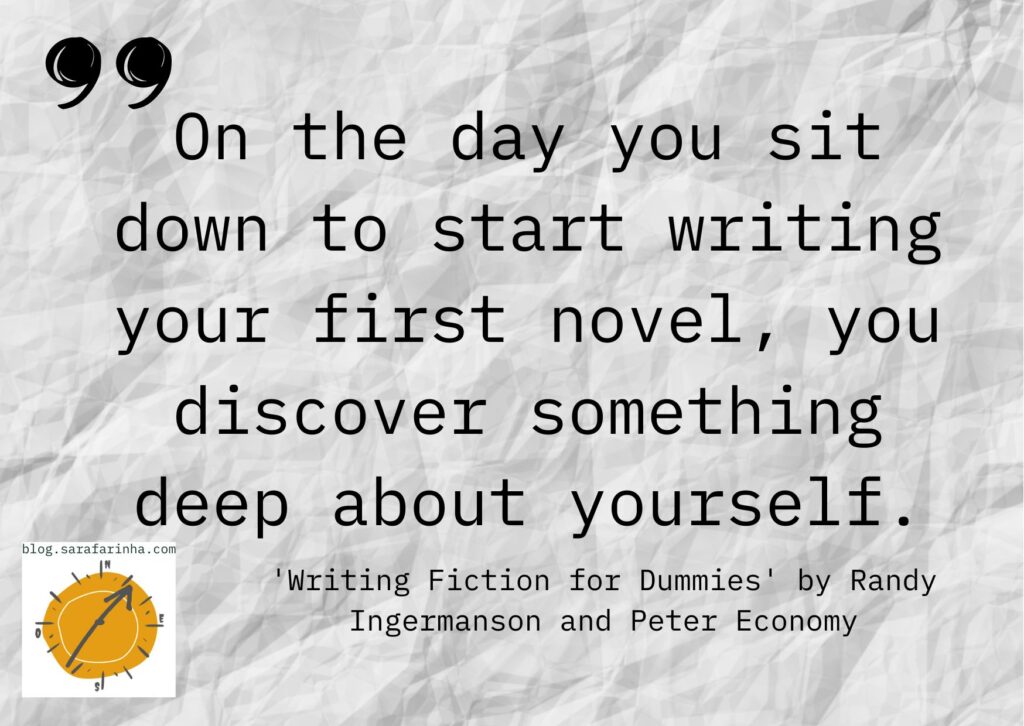
something about yourself

I don’t believe this was meant to be taken literally. But, yes. When we start to write our first novel we discover many different things about ourselves.

Not all of them are as deep as implied here. But most most of them are of the life changing variety. 

The 4 Creative Paradigms

Picking up on the Creative Paradigms as explored on ‘Writing Fiction from Dummies’, meaning the methods we may use while writing the first and subsequent drafts, we have:

  • Seat-of-the-pants (write in one sitting, without planning or editing)
  • Edit-as-you-go (write without planning but edit thoroughly as you go)
  • Snowflake (write a general plan, adapting it as you go)
  • Outline (make a detailed plan, than stick to it regardless)

Our beliefs

When we start writing we want to be good immediately. We want to become the best. We learn how to do some tricks (those things that we read and thought them out of this world good) and pray they carry us into an organic, and not too troublesome, writing practice.

But, at that time, we hadn’t put in the how many?!?!?! working hours we need to have some proper insights on the work itself.

The pantser kind of is our first and most dearest friend. And he can stay that way if used for the parts where he does his best work, like imagining a plot.

So, a pantser writes his stories using the Seat-of-the-pants creative paradigm. A pantser writes fast, without planning much, making it up as he goes along.

A plotter write his stories using the Outline creative paradigm.

A plotter uses outlines to plan and write his story. He works out the kinks before getting himself into the trouble of writing a full draft.

My journey

Looking into my own writing practices, I have used all of the different creative paradigms.

Experimenting on what best fits my writing needs, seems to be my method, and I use them in different parts of the writing process also.

I believe it’s a good thing to respect each project and leave to it to dictate which method would serve him best. There are projects that ask for a quick plotting session and others that are best left to the heat of the moment inspiration.

But, one thing I had been noticing in my writing practice, other than it evolve regardless of should’s and shouldn’ts, is that each project seems to ask from me a different creative approach. 

As I’ve been working on different lengths and types of stories, I understood that some require a bit more planning from the get going than others. As well as, some ask for more improvisation in order to flush out more creative ideas.

Also, there’s a creative paradigm more fit for a first draft of a story, and another quite different, for a second or third drafts. Why? Some give us more leverage to explore, while others are more suited for working out the things that aren’t good enough.

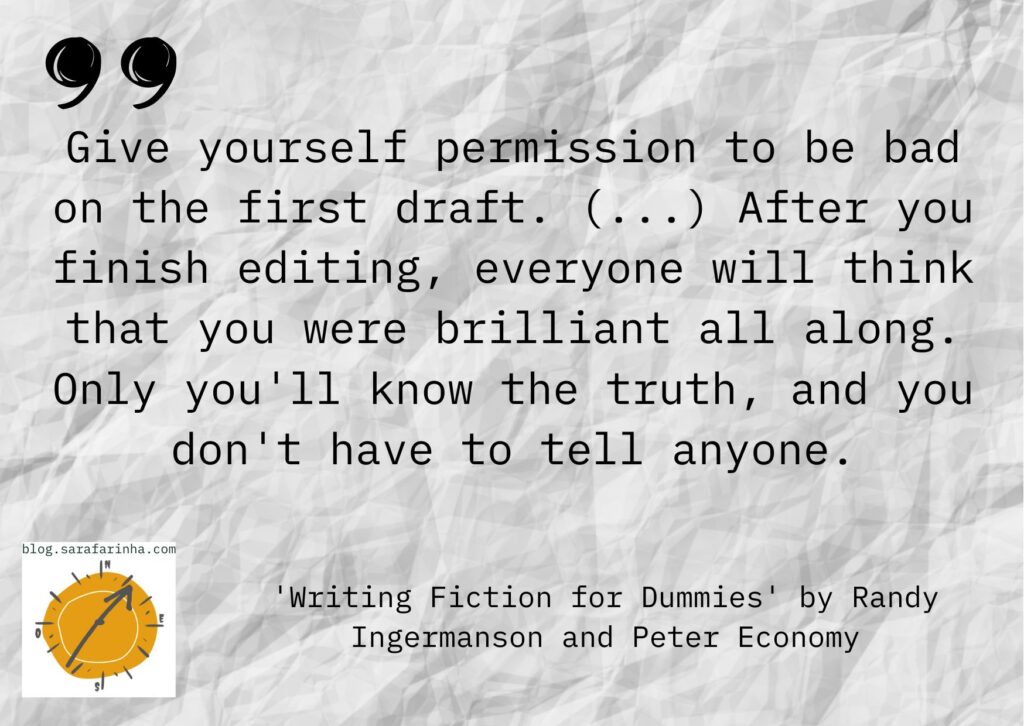
permission

I had been using all of them, sometimes both pantser and plotter on the same writing project, just in different phases (drafts or composition materials) of it.

But I kind of figured out that, when we start writing, and have a practice for some years, we get to evolve naturally into using more wholesome writing methods. 

We do not have the thrill of the major plot twist. I mean it in a sense of spilling everything onto the page with just that big goal in mind, not delivering on all the other requirements for a good story.

With practice we get to appreciate the composition of the story as a whole. Enjoying it best when we can work out all the details that will help us deliver that plot twist emotion seamlessly.

And it’s kind of easier to draft an entire novel if we have the guidelines previously written out.

Writing an extensive piece of literature is a tiring long run, a marathon, not a sprint. If we have the road clear, and all set up, we can walk it until the finish line, without many path corrections.

But I believe, the important thing to retain in this subject is: we show up to our work, we practice, we experiment, we write stories and we evolve as writers. Then, the creative paradigm will be our own, perfectly suited for our way of writing and being.

Hope you’re doing well and participating in this year’s NaNoWriMo. If so, how’s your project going?

Please leave a comment and subscribe for more content.

Bye and Keep writing! ✍🏼

***

References ✍🏼

Grounding the Writing Practices

grounding the writing practices

Today we are talking about grounding our writing practices.

Having trouble to face that blank page? To begin something? To just put your tutu on the chair? 

Yeah! I know where you’re at. Been there too many times to be willing to face them all.

A few years ago, my first big discovery to help me cope with this matter was a book (not a big surprise here! I tend to go looking for answers in books). 

It was “The Artist’s Way” by Julian Cameron, and it helped me face some things about my life and my choices, which stayed with me until today.

Other books helped me as well, but let’s not get on to all of those. It’s quite an extensive list.

Throwing in this mix, is a decade and a half of fiction and non-fiction writing, and I realised I have been teaching myself how to properly ground my writing practices.

Meaning of grounding

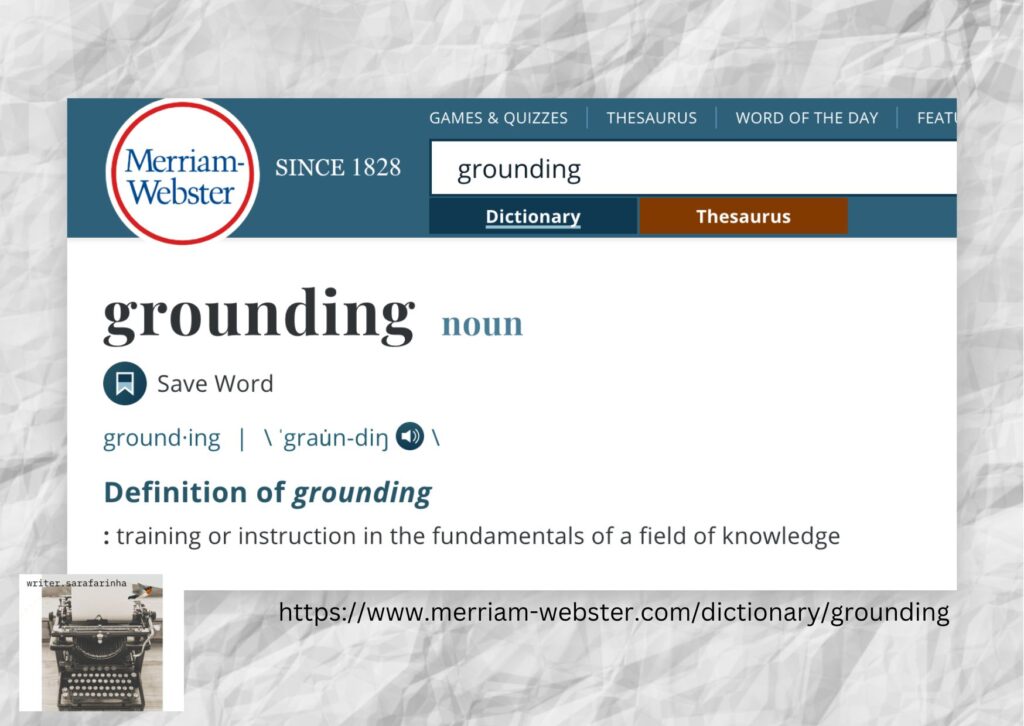
grounding merriam-webster

Grounding as in training or instruction in the fundamentals of a field of knowledge. But it isn’t fully that.

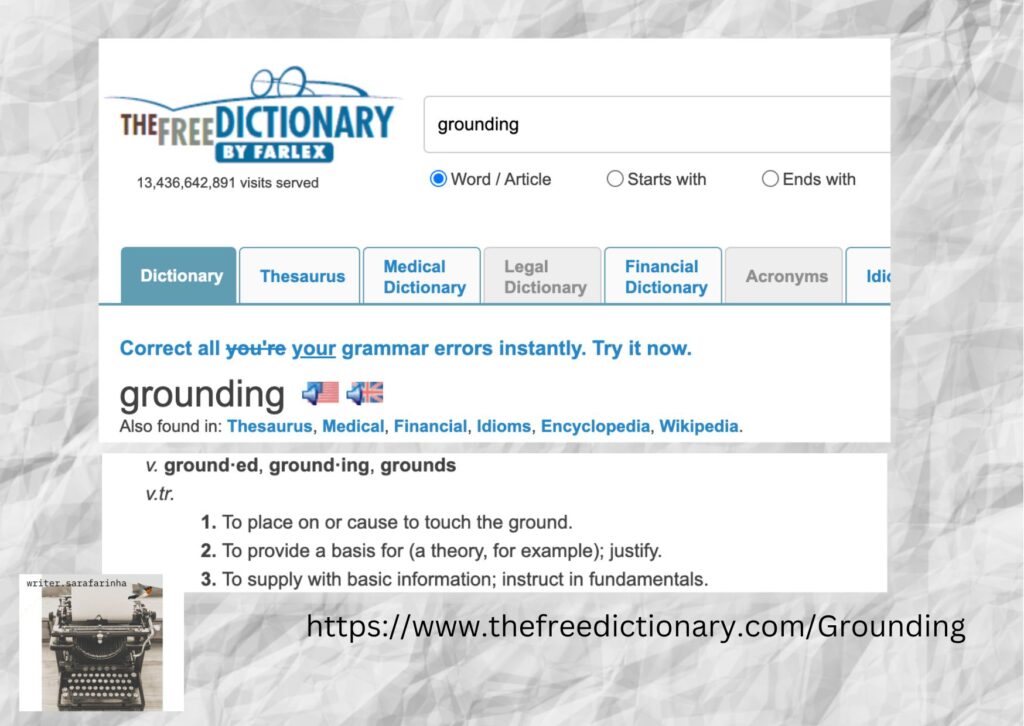
grounding free dictionary

Grounding as connecting something to its ground. To provide a basis, to justify, to instruct in fundamentals.

Grounding my writing practices in solid foundations to which I can return to every day.

What am I talking about?

When I start a new project, any project, like cooking a recipe, writing a paper, cleaning my house, take on a 9 to 6 job… the first thing I worry about is to learn about the task at hand.

Organising inside my head what it needs to be executed. Which are the rules applied, what tasks needs to be done, how to do it the best way I can. Reaching into past lessons and composing a how-to-do-this the best way I know how.

When I’m feeling less okay about it, or not enjoying the task at hand, I tend to avoid it by diverting my attention to other things… even if they are writing related tasks.

And by doing that, I loose my ground on the task that got me overwhelmed in the first place.

I had to learn how to ground myself on those works, that I wanted to be doing, even if they feel overwhelming.

Warming up to it

Trying to start something without proper warm up can cause injuries. I remember this from gym classes and it applies throughout.

To start writing without a proper warm up is just an injurie waiting to happen.

Inducing a mind space welcoming to the activity, is essential to avoid the black page block.

To ground myself onto my writing practices isn’t easy or learn-to-never-forget type of atitude. No, it’s hard and constant work.

So, in each day, I’ve come up with a few practices that help me ease myself into writing for the different projects I’m working on at the moment.

I first do something which usually gets me thinking and taking notes on something else. I set a scenery, a time, a place, in which I know that as soon as I enter it, I’ll sit and perform.

What I use to warm up

I choose to ground myself into my writing practice by using other means of input and output.

These include journalling, goal cards, collage, vídeos, music, meditation, even reading emails is good warm-up and a thoughts collector.

These practices help me ease myself into a mental state in which Flow can take over.

For example, “today” I started to write on my Mind Tools Journal and ended up with my notebook open, writing some short-story fiction, which occurred to me while trying to find a rhyme and reason on my yesterday’s tasks. From there, I went to this very blog post you are reading, and a short essay on a non-related theme… because I started to listen to some video-talk and it got me these ideias…

Producing isn’t Consuming

Please do not mistake these strategies with consuming stuff online. It is purposefully used to help me sit on this (or any other) chair, and proceed with my writing schedule.

And it’s not every day that I am working on building new stories. Sometimes, I’m editing, or revising, or marketing, or making other types of content.

Also, I have now a broader sense of what is included in my writing time.

Sitting myself to write fiction, also includes writing a story plan, some notes, scene cards, and whatever material I need to come up with a story.

It was not a very long time ago that I didn’t include my preparation work as writing time. I just saw the hours, in which I wasn’t scribbling away, inside the text document, that held the current work in progress. By those standards, I never did enough writing. (Not that I think I do enough. I don’t. I could always be writing more and I am working on that)

Copywriting is still writing. Poetry is still writing. Blog posts… daily journalling, ideas for books and videos, scripts for VLook…

I draw the line on writing shopping lists and excel files. Those I don’t consider writing, even if they are essential to the writer’s life.

How to make it work?

Grounding my writing practices, interconnecting them with my life’s daily tasks, feels like any other new habit we integrate.

For example, when we meditate we go to our mental space of calmness (some times more than others). We focus on the practice, ground ourselves to it, and let the breathing and the directed attention do their thing, to help us let go of all that stuff that’s weighting down on our minds.

Grounding on my writing practices started to feel the same way. Letting go of all the noise which emanates from our daily life’s and just focus on allowing myself to create something, to bring something forth.

It feels like entering a space, being transformed enough by being there, calm enough to play, focused enough to mentally open and let ideas flow.

Does it always work?

As much as any other focused practice.

Introducing a few grounding practices at a time, experimenting with what helps get our minds engaged and producing ideas. Allow these practices to form a true constancy in our daily life. Tying them to our writing practice.

There are a lot of exercises, like gratitude practices, keeping a schedule, or collaging next months goals in front of our desk, which can serve us in several ways.

And there are different practices. There are people which tied their writing practice to going somewhere, for example. Going to a coffee shop to write. To seclude themselves in an hotel room (like some well known writers), or go to a writing retreat… even to writing live on Twitch.

All these are grounding writing practices. They anchor the writing activity to some other event so, each time we are doing it, we have all the cues to start writing and no other solution than to write our time out of there.

It took me a few years to learn how to do this and a few more to understand why and how they worked for me.

And you? Do you have some grounding writing practices? What incentives do you use to perform? Are there any other practices you use to unblock your writing?

Please leave a comment and subscribe for more content.

Bye and Keep writing! ✍🏼

How books get us writing

writing craft books

I always get inspired when I read. I feel this a lot, specially if I’m reading non-fiction books.

Don’t get me wrong, fiction also gets me inspired, but in other ways. Kind of a different type of resources input.

If I read some fictional stories I usually absorb the inspiration of new ideas without giving it much thought. It’s like if the nuggets of wisdom get inside my head without effort or, let’s be upfront with this, get picked up in a less conveniente usable order.

Reading in our genre of choice can be a well of inspiration and, at the same time, a comparison tool that gets us crippled in our thoughts, if not in our actions.

When I pick up a non-fiction book, if it’s really good, usually I get a bit hung up on it, trying to take all of the great ideas, underlining it and even taking pictures of entire pages, so I don’t forget what I read.

I did a pretty good job of underlining almost every word of books like “Turning Pro” from Steven Pressfield.

This feeling of discovery of a meaningful work is the best inducement for my own creativity. I read it and I wish to share it with the whole world!

But then I hit the meca of inspiration…

Books on the Writing Craft 

Reading what others have written about the Craft usually represents a well of inspiring information.

And not just from the nuts and bolts part of it (“The Art of Fiction” by David Lodge comes to mind) but also from those inspiring essays and articles which form a lot of a writer’s daily work.

“Why I Write” by George Orwell is a good and inspiring essay.

It’s feels like we are given access to the minds of these esteemed authors and creatives, and we get to learn from their personal struggles.

Learning about the particulars of their writing craft, how they see writing related themes, the importance of taking notes and more. Through their experiences we get to work things out for ourselves, and use it all to advance in our own practices and ultimately, to know more about how to be a writer seems like.

“Bird by Bird” by Anne Lamott comes to mind here. It is one of the best books on writing ever!

Reading about the Writing Craft (and other related crafts) give me tools to practice on composing my own works, testing how to’s, and giving me insights and choices.

I always feel that, through reading I am given the lay of the land and a compass to help me find my bearings, through other writers thoughts and experiences on the matter.

I recall reading Rainer Maria Rilke’s work, part of his letters and his biography of sorts, through different sources, and got an immediate sense that it was okay to write in formats not attributed immediately to literature, like letter writing. 

His work lifted a boundary for me on what I thought was a formal writing practice.

Writing letters was fine too. And this got me more at ease with some of my writing activities and abating in that sense that if I wasn’t writing a long genre novel, I couldn’t consider myself to be writing at all… even if I had other ongoing projects at hand, like poetry, and short-stories, notebooks of sorts and (even) blog posts.

This notion was a major breakthrough! And reinforced my belief that books can bring us invaluable knowledge.

I do not consider myself a fast learner. Sometimes I take a really long time to perceive the obvious of a situation. But I always believe I capture other informations, less obvious, about a subject, theme or situation. Sometimes, how I feel about something is my firm indicator of an approachable way to get to know something more profoundly.

I also feel I lack the formal education part of the writing craft and I have found my teachers in books. I feel they help me learn about craft in ways that are more palatable to myself and less structured than a three years degree.

Sometimes online courses are an option and are a great pastime. But they kind of feel like a vanity pursue more than a formal experience. Which is fine, but not always to my liking. Specially because the very good one’s tend to be expensive and it’s crucial to manage all of my resources wisely. 

Books are a teacher of sorts. Through them we get access to formal knowledge, find some good contemporary mentors, or non contemporary ones, and they propose to take all our doubts away… specially if we read a lot and in different fields of knowledge. 

Books are great helpers, good friends and excellent teachers. They answer all questions, patiently give their support in our pursue of knowledge, are always available to repetition, and nurture our creativity.

Finding the answers through books is just a more slowly process to entail. But I like slow. To know is to repeat. To create is to live. To read is both.

Please leave a comment and subscribe for more content.

Bye and see you soon.