Hello all! Welcome back to this blog.
Let’s talk about writing… Let’s talk about my writing method.
These are the first three steps of the creative method that I’m trying to structure at the present moment:
1. Learn
2. Capture
3. Practice
If you read last week’s post, you may be aware of my attempt to organize my own creative method, and the path of better structuring the knowledge about myself, and how it impacts my own creative method.
This is a recurrent theme, to which I have dedicated much time, and that I want to share, as I’m weaving my way into its construction.
I believe we have the need to construct our own method, to which we will be able to turn to, whatever our current state of mind at any given moment. I feel this is essential to maintain a satisfactory creative existence.
I figure that to nurture one’s creative life we have to be able to see the nuances of the practice.
Contemplate a sunset, as he drops below the ocean, may induce me to go create something. But, many times, is the image of a, not so beautiful, ant that struggles with a crumb, that makes me think of moving impossible objects. Or, looking at a broken sea shell, and realising that its mother-pearl does not lose the creamish-pink beauty just because it has jagged edges.
So, why do we feel we need this sort of trigger to create something? And what do we do when he does not manifest itself at present? What art works do we create when the world pressures us in brutal, and hard to reconcile, ways if we need the peace to inspire us to create?
Not every one of us are prone to social intervention art creations, or aim to build art that will change the world. Sometimes, escapist art it’s the best contribution to society one can give, to the thousands that need the boost of a helpful piece.
To facilitate the trigger that leads to creative construction is part of finding our own personal method, which allows us to work on our art, without depending of the mystical and elusive inspiration.
To wait for inspiration to start creating is not a long term sustainable creative method.
But, to be aware of what surrounds us, in accord to what we thing about such experiences, is the fountain from where we drink to create, and part of our own personal method.
To think in showing up to a page and write something, is to know that, if inspiration is pushing us to ‘create! quick! don’t think, act!’ the process seems easy.
It appears to be what we have heard of what an artist should be: struck by a genius idea, and the rushed frenzy of putting the idea into the work of art, whichever form of choice… a page, a canvas, an uninterrupted role of paper, a digital file.
But, how many times does this happen? And how do we build a regular work practice when all we do is create when we are inspired?
I believe that it’s in moments of quietude, those which are spent contemplating outside things, while inferring what’s happening inside us, that feed the creative act.
To see something differently, and regularly build and adding to its meaning, means that we need uninterrupted time for the creator with its thoughts, and a multitude of experiences that help him recombine his ideas.
It’s not the velocity that provides consistent work. It is the stable progress, discovering in little increments, and showing up to organize which are our ideas, about the artistic means we have chosen.
It’s in the nuances, in which we build ourselves that we may, and should, come up with the system that helps us lead a creative life.
It’s in the experienced differences, in ways of being and creating, that need to be respected when we establish our own creative method.
Not forgetting that, to learn from other people’s experiences is essential. After all, we don’t know what we don’t know, so we need to go and look for it. To gather ideas and knowledge is essential to any person, more if we speak of someone which desires to do creative work.
To organize our own experiences, with the intent to base a system with which we are intimate, and that guides us, is essential to the creative practice. We need to know what we are doing next, without too much pause or friction.
To know ourselves, without prejudices or artifice of exaggerated productivity, help us acknowledge when we work better, when we have the means, and when our experience is inspiration to something more objective.
And from this point on?
To learn through a pletora of sources.
To capture what we know, and what we continue learning, in ways that nurture the creative process.
And always practicing our art.
My best method, or that which I recognise as the beginning of my creative process, has three phases: Learn; Capture Ideas; Practice.
Which always happen simultaneously. This is because, to capture ideas which seem interesting to explore later is a constant process to be kept. To have a place, or several, where to note things down, is part of my resources always carried with me. And, to write it, practicing the art, is an essential output.
1. Learn
Learn the relevant techniques. Learn what others, before and contemporary to us, have added to the themes. Learn the basic details, and the more advanced knowledge, as is possible. To learn is the Creative Input that we need.
To ponder: Sources. Quality of our Sources. Diversity of experiences. Research work. Thinking process. Iterating processes. Hyper-focus on what we are captivated by (no guilt).
About exposing ourselves to different experiences: what we experience embeds itself in who we are, and what we do. To broaden our activities, meet people, go to spaces and experience other artistic manifestations… we end up finding out that we really love to collect theatre brochures, photograph art pieces, rock climbing, volunteering, going to music concerts, pottery workshops… whatever it is that makes us happy and ready to use that information/inspiration.
All materials, or experiences that teach us something, are valuable.
2. Capture
At the same time, learning implies to have the means to capture what we learn, and build the personal iterations about the different matters.
External: I have experimented almost everything that I’ve came across, on the process of Capture of relevant information, and the ideas that were brought from those experiments. Even on my most difficult moments, I have tried to keep my records and even adapted this process, when my health required a more thorough process of capture, than the one I was accustomed to.
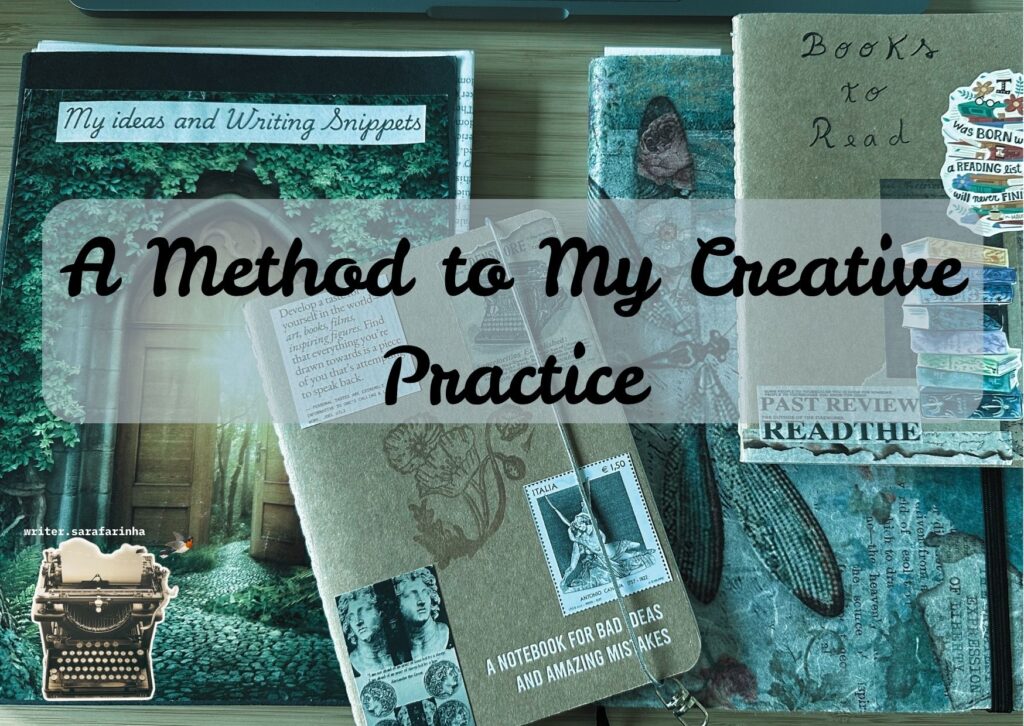
Daily calendars, online calendars, diary, dedicated notebooks to each project, photographs, photocopies, commonplace books, A5/A6/A7 cards, text and calculation files, organisational apps, right until creative challenges that asked for a continuous writing, painting or collaging, for a set number os days, a precise and regular practice… I have experimented all that sparks my interest and I find it most enlightening of our personal tastes.
For now, I have a small notebook for Capture all the information. And this is a entryway which works for me. I prefer to have this capture notebook, accompanied by the notes app on my mobile, adding the pertinent photographs to my photo library. I am also a frequent user of Canva, in order to organise all this input of information.
From this Capture notebook, I then copy the information to the correct project notebook. If its an idea for a book, I’ll put it in the project notebook. If it’s a reference to add to an article , I’ll put it on the first drafts notebook… and so on.
All these project notebooks have started to be organised in a particular way but, about this, I’ll write in some other article, if you have interest on the subject (let me know in the comments).
Internal: What I Capture might generate an idea. I’ll write it down in the capture notebook, and add a photo or other relevant material, to remind myself from where the idea came from. For example, all that comes to me when I read a book is noted on the margins and copied to the Capture notebook or dedicated Project notebook, as soon as possible.
I’ll let my internal monologues be influenced by what I see… if it’s a painting, and it reminds me of a character, or a possible personality trace, I’ll capture that connection and, later, I’ll transcribe it to my project notebook.
3. Practice
Every first draft, whichever project, has a dedicated space. A physical or virtual space that does not obey to any revision work. I’ll write what I want, in a first draft so messy as he requires, and leave it on the waiting cue.
Some books take years until I figure out what a better draft requires.
Writing blog posts and Substack newsletters take less time than other forms of fiction writing, but some of these never see the publication date arrive, even after days on end of revisions. “One simply is not fit to be seen.” (‘Persuasion’ by Jane Austen)
Other blog posts, end up supplying the main idea to other article, even if totally different from the initial iteration.
To put something in the world, the Creative Output, is the main goal of the previous actions: learn and capture.
Memorize to future use
In light of this, I cannot help but think that it is important to consider memory as essential to it all. This creative method is, simultaneously, a group of strategies that help me keep the information that crosses my path, so I don’t forget, to repeat it until I memorize what I need, in order to recombine ideas, and use them in my writings.
This is a process that helps me remember what’s important, and the most relevant details from those experiences. If I did not make the effort to write down, and remember, the positive experiences, soon only the negatives would have space.
Life is made of too many memories, which we unintentionally forget, or that we need to arquive somewhere in a less accessible spot. But, to practice our arts we need memories, and the ability do memorize, and not just those which are more emotional impactful, but also the ones less dramatic.
To have processes in place to maintain constructive memories, that I wish to keep, has been determinant to my memory, and helped narrowing the uncertainty of some memories, even if it does not save me from the normal cognitive biases, that are certain and assist us all.
So, these are the first steps of my creative method: Learn. Capture. Practice.
Not the solo ones of this method, of course. But they are the infrastructure on which I build upon. Part of growing my own garden.
I hope this glimpse of the entry point on my creative practice is of some use to you. I’ll share other strategies and methods in due time.