Hello all! Welcome back to this blog.
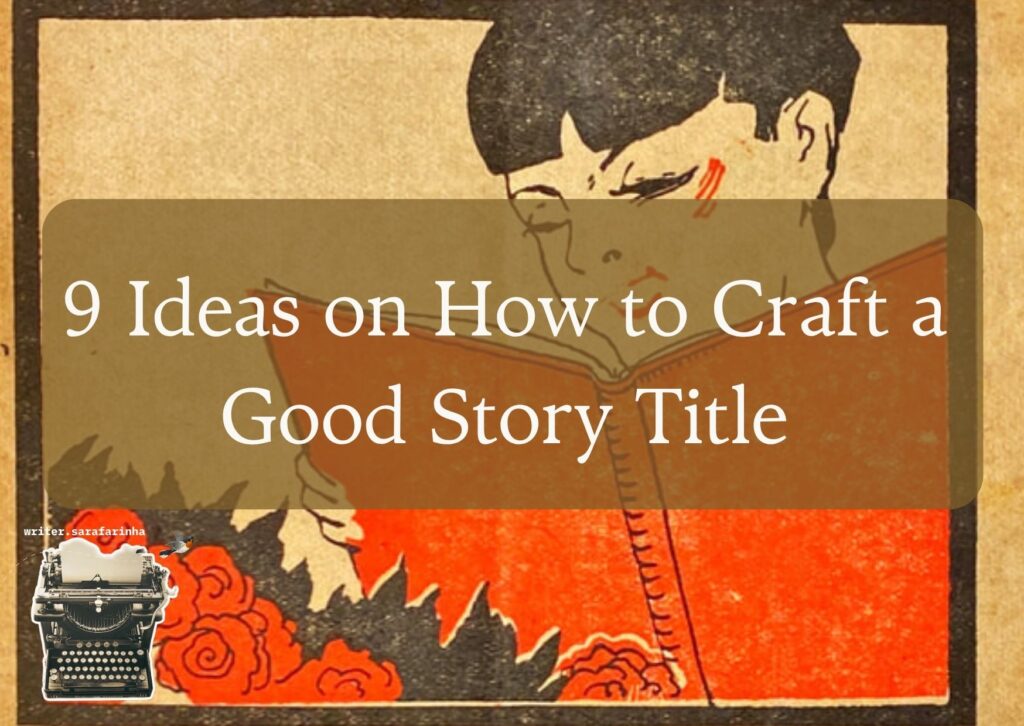
Let’s talk about writing… Let’s talk about crafting good story titles.
Crafting a good title requires us to put things in perspective. So, how does choosing a story title works?
First, there is no magical formula for crafting a spectacular title. Also, rules for crafting non fiction, articles, essays, and even poetry, are mindful of their differences, not just in genre, but also respective formal conventions associated to them.
Still, for all of us readers, the title is the front door of our text. A good title opens the door to the reader and invites him in. A bad one, narrows that door opening, or even closes it firmly.
How many times has a book title invited us in and make us curious to read it? Many. And, I recall “An Inventory of Losses” por Judith Schalansky as one of my most recent examples.
The attention economy implies that titles, as the label which represents its content, must be able to fulfil the economical rules of the most valuable resource: readers attention towards your text.
Bad titles scare readers away, even editorial readers in submission processes. An experienced editor absorbs a lot from that first impression on a title.
As you work with an editor, if the title isn’t good enough, and you do not envision how to write a better one, someone will suggest another. And, it probably will not correspond to what you had envisioned for your work. Been there, more than once. And it is not pretty.
Therefore, I’ve committed to articulate what I know, from experience, about the different aspects to consider when we are crafting a fictional title, with a few tidbits overlapping for other genres.
9 things to consider:
1. Read and Compare
Read similar texts to yours, and compare the published titles. Observe how these titles are crafted, their characteristics; what do they make us think when we read them; on the first time and repeatedly; are they made of a long sentence, or a short one; or they have a subtitle; what do they make us wonder right on the first impact;
Compare those with your title options.
Each literary genre has a typical title construction. Learn what the similar text titles say about your genre preferences.
2. What do you see?
Think about other titles. What captured your attention? Did it made you buy the book? Read it? Which words are used? Did it make you laugh? Did it offered you a solution to a problem? Is it a useful to do list? Is it poetic? Is is simple? Complex? Obtuse? Does it have a double meaning? Uses stylistic resources? What does it mean to you, before reading its contents? Is it emotionally charged? In what way does it affects you? How do you relate with it? And what do you want to emulate or avoid in your own title?
These reflections give you clues about the best process to craft your titles.
3. Surprise!
Foresee something importante in the story context. A title is, or should be, alluding to a deeper meaning in the story. A great title is representative of that most important element, without revealing too much.
Which messages are important, in a text that you have read, that connects to its title? As you were reading the book, did you spotted the place where the story gave the writer its title? Is that relationship, between text and title, direct or indirect?
An example of this, as I recalled “Never Let Me Go” by Kazuo Ishiguro.
4. Have you seen me?
Search for expressions, in our text, that may be titles in themselves.
In poetry it’s common to look for expressions in the text that stand as titles. And when we need to give a poem a title, to publish or identify it, we may use the first verse as a poem title, repeating it as title and as the first line of the poem.
In fiction writing, we may search for a short sentence, a meaningful expression that we have written in our text — not a clichéd, — which represents the work in a curious ways. We may find in it the words that make the title work, that is meaningful and has an immediate impact. But, keep in mind that it is important to maintain a relation between content of the text and its title. The title should always be linked to the story through a symbolic way.
5. Change the order of the proceedings
Sometimes, the title comes first to us. When we kind of have an idea of what we are writing about. Or when we did some research and plotted some of it. Or, even when our intuition says ‘this is it, and it’s final.‘
In other times, the title only comes up after a first draft… or a final draft. So, I’ve learned not to try and push the event. The title will surface. I will build it as I’m building the story, listening to what my gut tells me. It does not appear through magic… even if, sometimes, it feels like it.
While time runs his course and I’m working the story, titles pop up, and I’ll reiterate them as needed, until I find a version that feels right. But if you feel that the initial idea for the story already comes with a possible title attached, do not discard it just because is an initial thought. Write it down and rethink it later.
6. Make lists
Write several iterations of a title. Write down the fleeting ideas that come along. I can’t tell you to ‘write it all down!‘ because, this is not always the best option, as we do not need more friction caused by excess.
The three title options are confusing us already. We do not need to deal with a dozen more just because we are unsure of our choice.
But, if you feel that you need a brainstorming session, or two… write down your ideas, about what could make a decent title, put down words related to your story, or other titles iterations, and what you feel about those. Find yourself a set from where to pick from.
7. Research
So, you already have a possible title, or a short list of options… open a browser tab and search that title. Research all your book title ideas and allow the internet to give you the basics: if there is another title just like yours, or pretty similar to yours; when was it published; by who; in what genre and themes…
Sometimes, there are works published with pretty similar titles, at the same time. And even if this can be some sort of modern strategy to sell more books, it is pretty risky.
For readers, it is just confusing, potentially inducing deceptions, and frustrating expectations. And, to me, is giving a not so proper image of the writer, showing an intentional duplicity, that I do not appreciate.
And, do not forget to research the meanings of the chosen words for the title. We should check if their meaning is appropriated to the title we want. There are several words with alternative meanings, specially if they are time apropos or culturally relevant, and that are imbued of other meanings. There’s a need to evaluate those possibilities and make sure that the words we use are intentional.
8. Distance text from the antsy to scratch something about it
It is not uncommon to write a whole text and still be confused about the appropriate title for it. It happens to me, all the time, as I frequently battle with articles titles, like this one.
It helps to distance ourselves from the text. Finish what we are writing, save it, and go for a walk, do something else, take a brake with a activity more physical, relaying the theme processing to our unconscious mind.
Our minds keep trying to solve it or, at least, processing the challenge that we have given it, and it is not rare to come up with a solution as we are doing something else entirely… while taking a shower, run an errand, or doing something else, that is not the direct process of ‘thinking about it‘. As the possibilities might arrive at odd moments, it’s important to have where to wrote down those ideas for future use.
9. Not this, not that, not these
The title should not be too generic, nor too specific. A generic title just sufficiently not to become dark and incomprehensible. Or, a title so specific that tells it all at first glance, and strips the reader of any curiosity about the text itself.
Also, it is not nice to use cliched wordings. Those well-known phrases that frustrate the reader at first glance, for their plainest view… even if it feels appropriated to the story itself. A common expression of this kind has to rely on a perceived trust that the reader has the correct popular meaning of the sentence, when most of its roots are buried in time or, frankly, outdated or culturally misplaced.
*
Any title should be well research before it’s put up for submission process and/or publication. And yet, there’s always the risk of not being able to use it. In this matter also, it is needed for us to be moderated in our wishes and possibilities.
It’s better to have a published title, even if it’s not what we have dreamed of, than a confrontation, which may be hard to deal with or have a good outcome.
We need to put things in perspective, just like what is required of a title: to put what we are reading into perspective.
And after reading it, we may be able to confirm, or disproof, the title’s initial perspective.
∞
Subscribe for more writings about Writing. Help me grow this blog and keep on sharing the writerly talk.
Bye and Keep Writing! ✍